
Ancient Rome
Slavery and the gift of Christ
We have many things today which we owe to people who lived thousands of years ago. From the Persians came the plough, as well as fruit-trees, garden-flowers, wheat and barley. From Babylon came bricks, the first carts and chariots, the knowledge of measuring time. From Egypt came the art of writing, and from the Greeks came arts, theatre, sport, the sciences, and democracy.
The time of ancient Greece already had much knowledge—there were great and wonderful works of art, and human beings had even learned the power of independent thinking, no longer having to rely on dreams.
But even the best and wisest of Greeks thought it quite natural that there should be slaves. For instance, the Spartans were only trained to be warriors, and slaves worked the fields, cooked and served the food. In Athens, the rich Athenians had time to listen to beautiful speeches, to spend days in the theatre, to practice sports, only because all the heavy work was done by slaves. The Athenians had great architects who designed the beautiful temples and who supervised the work, but they did not carry the heavy stones for pillars and walls, they did not cut the stones, all that was done by slaves.
The ships which carried people and goods across the seas had sails, but when the wind came from the wrong direction, or there was no wind, slaves had to row to move the ships. Even warships had to be rowed by slaves.
Often these slaves were chained to their benches, so when a ship sank they could not even save themselves by swimming.
All the hard, unpleasant work was done by slaves. Most Greeks treated their slaves well, if only because a slave cost money, and if he was underfed or mistreated he might die, and a new one would have to be bought. But if a Greek happened to be mean and cruel, he could hurt and beat and even kill his slaves. He was quite free to do so, for a slave was his property to do with as he liked. If a slave ran away he was nearly always caught and condemned to death as a warning to other slaves thinking of running away.
Slaves could only marry with their owner’s permission and if they had children these were also slaves, and the owner could take them away from their parents and sell them whenever he liked.
In every city of the ancient world, in Greece, Persia, Egypt, there were slave markets where men and women, boys and girls were sold, just as we sell sheep or cattle or horses. And no one ever thought that there was anything wrong in treating human beings like this. Even the wisest and best people of that time did not have the feeling that here is a fellow human being, just like themselves; they really did not feel it.
An Athenian had a certain feeling of brotherhood with other Athenians – but already a man from Sparta meant little to him, and a man who was not Greek at all, a so-called barbarian, was hardly regarded as human at all. In Greek times and later in Roman times there was no feeling that a human being is something that cannot be bought or sold like a piece of furniture.
But then in Roman times, something quite new came into the world. Christ came and He gave the world the understanding that all human beings on earth are children of the Father in heaven. We each have our own earthly father and mother, and, perhaps, some brothers and sisters, but we all have one Father in heaven; we come from Him and we return to Him. And through the Father in heaven all human beings are our brothers and sisters and they are all equally dear to Him. That was the precious, wonderful gift given to all children of God. It was the most important thing in the whole of history.
Now that was something so new that many people could not understand it at first, and they even turned against Christ. Even in our time there are people who have not quite understood it and hate and hurt each other. But such great things take time to work, and in time all humankind will understand it.
The gift of Christ has already brought one great change since Greek and Roman times: no one would like to have slaves today. We would feel it as something horrible if there were a slave in our house who would live in fear and dread of us, whose life would depend on our whims and moods. A Greek or Roman would have thought it quite natural. So you see how much life has been changed.
In our time we feel it is against human dignity to have slaves, even if we treated a slave well and with kindness, it would still be wrong. It is against the dignity of a child of God that he should be treated like a pet-dog.
The great painter, Leonardo da Vinci, showed what Christ had given to mankind when he painted the Last Supper showing Christ among his disciples. Christ who is so much more than an ordinary human being, Christ who has divine powers, and around Him the men are not his slaves, not his servants. Each one of these men speaks quite without fear. Some are old, some are young, some are excited, some are calm. But the words which Christ says go to the heart of every one of them, different as they are. These men are united by the love of Christ, and not by the command of a master whom they fear because he could destroy them.
So in this picture Leonardo showed the new thing Christ had brought into the world: love for every human being, for we are all children of the Father in heaven, and respect for human dignity, for every human soul is dear and precious to God. One cannot buy or sell a human being who ultimately belongs to God.
We saw that as men learned more and more things to make life on earth pleasant, as they became more and more “at home” on earth, the Kingdom of Heaven became darker and darker for them. For the Greeks and Romans it was already a world of dark shadows. But for those people who followed Christ, all this changed: they could feel the light-filled Kingdom of God near, they no longer feared death, because love and kindness not only brings human beings together, they also bring heaven and earth together. When we love others, when we care for others, the Kingdom of God is in our hearts.
This is why the coming of Christ is the most important event in the whole history of mankind. All the dream-wisdom of the ancient peoples, all the clever thought of the Greeks, all the beauty of Greek art, they are like nothing, compared with what Christ brought. And all the inventions of our time – cars, planes and computers – they are very little compared with the gift Christ brought, because what good would all this be if people live in fear and hatred of each other, if they destroy each other in wars?
But such a great thing as Christ brought takes a long time to grow and to reach all human hearts. Even now we are still far from living like brothers and sisters on earth.
And, at first, it was even worse, for the Romans, who came after the Greeks, believed in power and not in love.
wandering around ithaka
summary
The deepest shift in history did not come from power or progress, but from the quiet recognition of the sacredness of every human life.
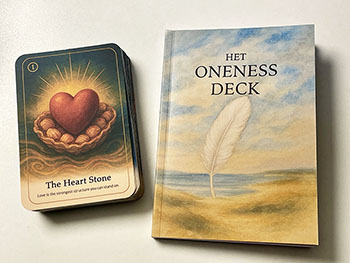
Order the Oneness Deck
If you feel drawn to bring this companion into your life,
you can reserve your copy of the first limited edition here.
There are printed at the moment and will ship after Christmas.
Thank you for your interest.