
travels with my dad
The journey that continues
CaptKo
My father passed away when he was seventy-four, which felt far too young to me. I was living in New Zealand at the time. My children were two and four years old. When my daughter was three months old and my son two and a half, we moved as a family from Amsterdam to New Zealand. For our whole family, that was a difficult step. I still remember very clearly how I got into the taxi early that morning, heading to the airport. I didn’t want anyone to come and see us off, because the departure felt like one of the most difficult moments of my life.
Shortly before that, my father had been diagnosed with cancer, and yet, miraculously, he seemed to be improving. My mother put him on a strict health regimen, and he followed it with great discipline. One of his motivations was clear: he wanted to come to New Zealand to see how we lived, and of course to see his grandchildren again in their new environment.
My father had always been a traveller. Perhaps I inherited that wanderer’s blood from him. He was a captain in the merchant navy, and later, when he came ashore, he worked as a vice president at a shipping company. He knew the world, and the sea lived in him, in his whole being.
After a year of preparation, my parents were ready to come to New Zealand. They stayed with us for six weeks, and we had a wonderful time together. My father saw my daughter walk for the first time. She covered his slippers with stickers, which he proudly took back to the Netherlands and continued to wear ever after.
Not long after their return, the cancer came back, in a different form. We more or less knew that he was living on borrowed time. During that final year, I spoke to him on the phone very often, and each time he told me not to come back to see him. “We can just as well talk like this,” he would say. “I’ve just seen you, and the children are still too young for such a long journey.” He passed away that same year.
I didn’t return for his funeral either. That was hard, but it also felt the right to do strangely enough. He had asked me explicitly not to go. A month later, my mother came to New Zealand and brought a letter from him. In it, he wrote that he loved us, and that it had been good that we had spoken so often during that last year, that we had said everything to each other, and that he was at peace. “Now it’s your turn,” he wrote at the end.
After his death, I had a dream. I was standing in a large bus station in America, a place he used to visit often for work. Behind a glass wall, I watched my father step onto a Greyhound bus. He was young, about twenty-nine, full of energy, laughing, radiant. I felt happy for him. We waved to each other, and I felt joy and sadness at the same time.
The bus started to move, and as I kept waving until I could no longer see him, something special happened. The bus made an extra loop around the roundabout and passed by once more. He was still sitting by the window, smiling and waving. It felt as if he wanted to say: we don’t really have to say goodbye. That moment planted itself deeply in me, like a seed of knowing that connection does not end with death.
In the years that followed, I took various trainings in New Zealand to do healing and personal development work. The most important thing I learned through them was how to connect my heart with something larger.
One morning, I was driving to Auckland, a journey of about two and a half hours, to attend a workshop. The day before, for the first time since his passing, I had printed a photo of my father, one of him in his captain’s uniform as a young man. For a long time, it had felt too painful to have his photo in the house; I preferred to carry his image within me. But now it felt right to see him again.
Just before leaving, I picked up the photo and placed it on the dashboard of the car. “I’m taking you with me to Auckland, Dad,” I said out loud.
After driving for a while, the seat beside me started to beep, as if the seatbelt wasn’t fastened. No one was sitting there, only my backpack, which had apparently become too heavy. I put it on the floor, and in that moment I felt it very clearly: my father was sitting next to me.
I began talking to him, a little awkwardly. He had never been a big talker, more of a quiet, reserved man. And I could almost hear him say: we don’t need to make small talk. I stopped talking and for the rest of the drive, I felt his presence, calm, steady, familiar.
At the workshop, we were asked how we had arrived that morning. I said, laughing, that I had brought my father with me. When they asked his name and I said that he had been a captain, someone exclaimed, “Ah, Captain Ko.” I showed the small photo and placed it on the empty seat next to me.
The weekend brought many insights. I realised that until then I had mainly lived from my feminine energy: caring, connecting, holding. But now I felt something shifting. My children were growing older, and my own desire to create was opening again. And I felt my father supporting me in that. As if he were whispering: it’s time for you to sail your own course too.
On the drive home, I still felt him beside me. There was a comfortable silence between us. As I reflected on the weekend, I suddenly felt that he was moving away. At that exact moment, a black car overtook me and pulled in front of me. I looked at the licence plate and read: “CAPTKO.”
I could hardly believe it and drove closer to check, but it was really there. I stayed close behind that car for at least half an hour. I felt my father’s presence beginning to move on, but I wasn’t ready to let him go yet. Eventually the car turned off and disappeared.
Everything felt complete. He had shown himself one last time, clearer then ever, almost in a form I could touch, and it filled me with wonder. At the same time, I felt calm, clear, and very much at peace.
Since then, I know that my father still travels with me. We are still in conversation, just on a different frequency. Where there were once moments of friction between us, I think we both had a strong character, there is now calm, clarity, and a formless love, with a new, clear guidance from the universe of which he is now part in a different way it feels.
His passing has forever changed my view of death. I still miss him, but more and more often I can turn that missing into gratitude, and that sorrow into connection. I feel him most strongly when I become still and joyful.
He is not gone; he is simply travelling with me in a different way. Sometimes we move along our own currents, and then suddenly we are side by side again, continuing on, as if we never lost each other’s course.
The journey is without end.
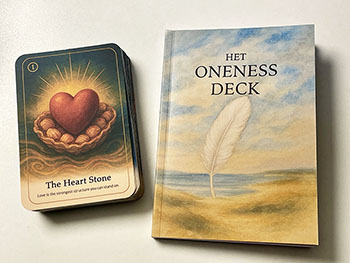
Order the Oneness Deck
If you feel drawn to bring this companion into your life,
you can reserve your copy of the first limited edition here.
There are printed at the moment and will ship after Christmas.
Thank you for your interest.